


Today, we’re going to explore 3 Powerful Ways to Sound Polite in Swahili. But first, let me create a scenario for you.
Have you ever walked into a meeting ten minutes late, dropped your coffee, or completely missed what someone just said? We have all been there. Navigating everyday communication can be a minefield, especially when you’re trying to speak a new language without sounding rude, dismissive, or downright clueless.
If you’re learning Swahili, you probably already know basic greetings like Habari or Sijambo. But if you want to sound more natural, understand conversational etiquette, and navigate uncomfortable moments with grace, you need to go beyond surface-level basics.
Table of Contents
Swahili communication places a strong emphasis on respect, tone, and politeness. Using the right phrase at the right time can make the difference between creating a warm connection and unintentionally coming across as abrupt.
In this article, we’ll look at 3 Powerful Ways to Sound Polite in Swahili using three practical expressions built around the phrase Samahani Sana. We’ll explore what each expression means, when to use it, how to pronounce it, and how to make it part of your everyday Swahili.
The Power of “Samahani Sana”: Why Politeness Matters
In English, a quick “sorry” or “excuse me” can sometimes be used almost automatically. In Swahili, Samahani is also extremely useful for apologizing, getting someone’s attention, or politely acknowledging an inconvenience.
The word Samahani can mean “sorry” or “excuse me,” depending on the situation. Adding sana, meaning “very” or “much,” makes the expression stronger.
So, Samahani sana can communicate a stronger sense of apology or politeness depending on the context.
When you use these expressions appropriately, people notice that you’re doing more than translating English words directly into Swahili. You’re beginning to understand how politeness works in real conversations.
Whether you’re running late for a meeting, asking someone for help, or asking someone to repeat themselves, these expressions can help you handle everyday situations more gracefully.
Now let’s look at the three phrases.
3 Powerful Ways to Sound Polite in Swahili
These three expressions all use Samahani sana, but each one is useful in a different situation.
1. “Samahani Sana Kwa Kuchelewa” — I Am Very Sorry for Being Late
What It Means
- Samahani: Sorry
- Sana: Very / Very much
- Kwa: For
- Kuchelewa: Being late / Arriving late
Together, “Samahani sana kwa kuchelewa” means:
“I am very sorry for being late.”
Why and When to Use It
Being late can happen to anyone. Traffic, transportation problems, unexpected delays, or simply poor time management can put you in an awkward situation.
Instead of arriving without acknowledging the delay, you can say:
Samahani sana kwa kuchelewa.
It immediately communicates that you recognize the inconvenience and are taking responsibility.

You can use it when:
- At work: You arrive after a meeting has already started.
- Socially: You arrive late to meet a friend.
- Traveling: You keep a driver, guide, or another person waiting.
Pronunciation Audio:
Listen to how it is pronounced and repeat it over and over again.
Keep the vowels clear and separate. Swahili pronunciation is generally consistent, so once you learn the vowel sounds, these phrases become much easier to pronounce naturally.
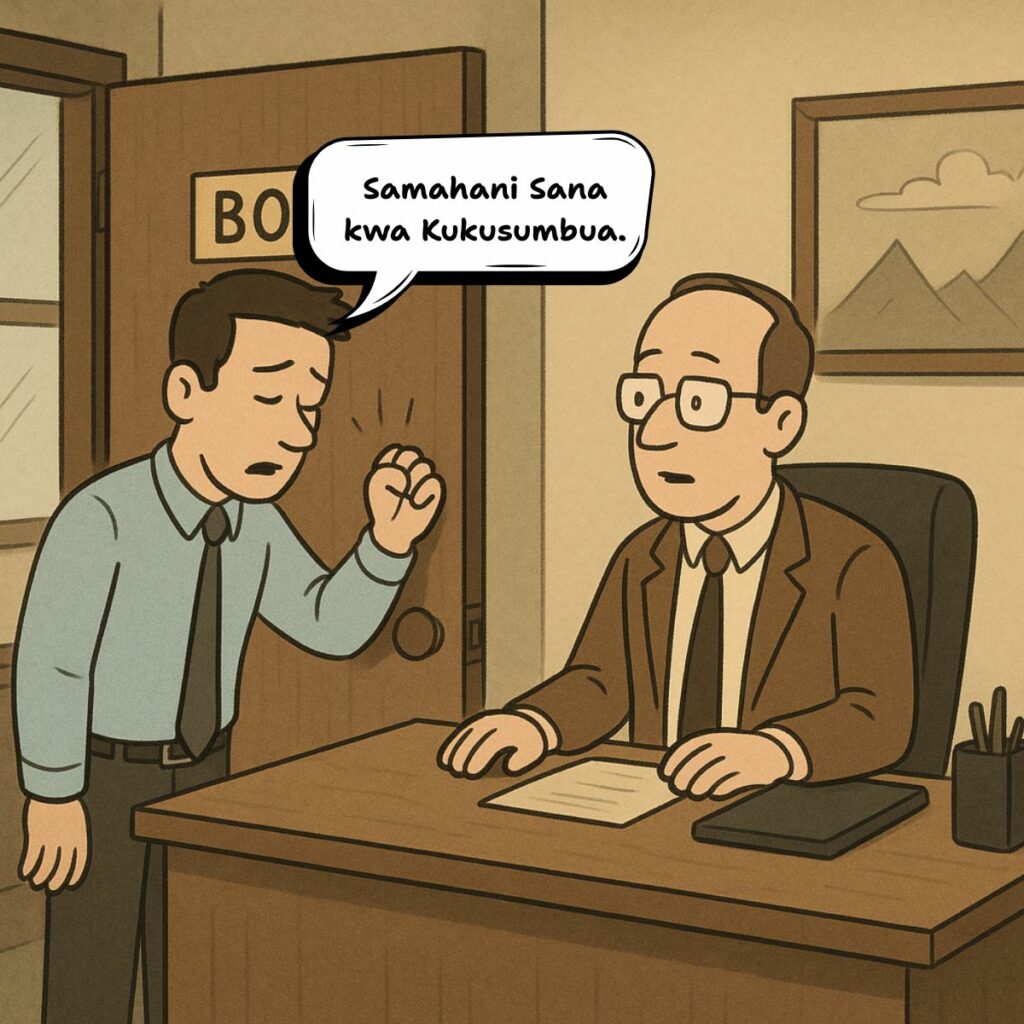
2. “Samahani Sana Kwa Kukusumbua” — I Am Very Sorry for Bothering You
What It Means
- Samahani sana: I am very sorry
- Kwa: For
- Kukusumbua: Bothering or disturbing you
The verb kusumbua means “to bother,” “disturb,” or “trouble.” The ku- in kukusumbua refers to the person being addressed.
Together:
“Samahani sana kwa kukusumbua.”
means:
“I am very sorry for bothering you.”
Why and When to Use It
This is an extremely useful expression when you need to interrupt someone, ask for assistance, or acknowledge that you’re taking someone’s time.
Imagine you’re walking down a street and need directions. Instead of simply starting with your question, you can say:
Samahani sana kwa kukusumbua.
Then ask your question.
In this situation, asking for directions can be done in another way. You can just say Samahani/Sorry. It is direct & clear; you will sound more local, because local people, especially in Dar es Salaam, use just Samahani.
You can use it when:
- Asking for help: You need directions or information.
- At work: You need to interrupt a colleague.
- Dealing with customer service: You need someone’s assistance.
- In everyday conversations: You need someone’s attention politely.
This is one of the 3 Powerful Ways to Sound Polite in Swahili because it gives you a natural way to approach someone without sounding too direct.
Pronunciation Audio:
Listen to how it is pronounced and repeat it over and over again.
With practice, the separate syllables will eventually flow together naturally.
3. “Samahani Sana Sikukusikia Vizuri” — I Am Very Sorry, I Didn’t Hear You Clearly
What It Means
- Samahani sana: I am very sorry
- Sikukusikia: I didn’t hear you
- Vizuri: Well / Clearly
Together:
“Samahani sana, sikukusikia vizuri.”
means:
“I’m very sorry, I didn’t hear you clearly.”
Why and When to Use It
Native speakers can sometimes speak quickly. Add background noise, a poor phone connection, or your own developing listening skills, and you may miss what someone says.

Instead of simply saying “What?”, which can sound abrupt depending on the situation, you can use this more polite expression:
Samahani sana, sikukusikia vizuri.
It tells the other person that you didn’t hear clearly and gives them a natural opportunity to repeat themselves.
You can use it:
- On phone calls: When the connection is poor.
- In noisy places: Such as markets, restaurants, or busy streets.
- While learning Swahili: When a speaker talks faster than you can follow.
Pronunciation Audio:
Listen to how it is pronounced and repeat it over and over again.
Don’t rush the word. With repeated practice, it will become much easier.
5 Practical Tips to Master These Phrases Fast
Knowing the phrases is one thing. Being able to use them automatically in a real conversation is another.
Here are five ways to make them stick.
1. Practice the Penultimate-Stress Pattern
Swahili generally places stress on the second-to-last syllable of a word.
For example:
- kucheLEwa
- kuSUMbua
- viZUri
Getting the rhythm right will help your pronunciation sound more natural.
2. Connect Each Phrase to a Real Situation
Don’t just repeat the phrases from a screen.
When you’re actually running late, think: Samahani sana kwa kuchelewa.
When you need to interrupt someone: Samahani sana kwa kukusumbua.
When you didn’t hear someone: Samahani sana, sikukusikia vizuri.
This creates a mental connection between the language and the situation.
3. Use Appropriate Body Language
Your words aren’t the only thing communicating politeness. A friendly expression, respectful tone, and appropriate body language can reinforce what you’re saying.
Don’t overdo it. You don’t need exaggerated gestures to sound polite.
4. Record Your Voice
Use your phone to record yourself saying each phrase.
Listen back and compare your pronunciation with a reliable Swahili speaker. Pay particular attention to vowel sounds, rhythm, and whether you’re rushing through longer words.
5. Start With One Phrase
Don’t try to memorize everything at once.
Start with:
Samahani sana kwa kukusumbua.
It’s useful in many everyday situations, making it a practical first phrase to master.
Once it feels natural, move on to the other two.
Learning a language isn’t just about memorizing vocabulary. It’s about knowing what to say, when to say it, and how to say it appropriately.
These 3 Powerful Ways to Sound Polite in Swahili give you three practical tools for handling common situations:
Samahani sana kwa kuchelewa.
I am very sorry for being late.
Samahani sana kwa kukusumbua.
I am very sorry for bothering you.
Samahani sana, sikukusikia vizuri.
I am very sorry, I didn’t hear you clearly.
You don’t need to master all three today. Pick one, practice it repeatedly, and look for a real situation where you can use it.
That’s how vocabulary turns into conversational confidence.
Have you ever experienced an awkward moment while speaking a new language? Share your story or question in the comments.
We hope these 3 Powerful Ways to Sound Polite in Swahili will help you add to your vocabulary. You can also learn 5 Daily Inspiring Swahili Introductions.
Please reach out to me by clicking my initials below.👇To learn more in private.
Until next time, Happy Learning.