

You will discover this 5 Common Swahili mistakes learners make. We wanted to write this article in order to help many who are learning the Swahili language. Learning the Swahili Language is one of the most rewarding journeys you can take, especially if you want to connect deeply with people across East Africa.
But even the most dedicated learners tend to repeat the same errors, often without realising it. It is common in any language to do that. Don’t worry about it.
Table of Contents
In this article, we highlight 5 of the most common Swahili mistakes learners make and show you exactly how to correct them. Whether you are just starting or have been studying for a while, this guide will help you speak more naturally and confidently.
Now let’s discuss those 5 Common Swahili Mistakes Learners Make and how to fix them.
5 Common Swahili Mistakes Learners Make
Now let’s look at one mistake after another. We will start with the first mistake.
Mistake 1: Confusing “Sijambo” and “Hamjambo”
This is perhaps the most common greeting mistake among new learners. Many people use Sijambo for every situation — whether they are greeting one person or a whole group.

The correct rule:
- Hujambo? — Used when greeting one person. The response is Sijambo.
- Hamjambo? — Used when greeting two or more people. The response is Hatujambo.
| Situation | Greeting | Response |
| One person | Hujambo? | Sijambo |
| A group | Hamjambo? | Hatujambo |
Example:
You walk into a shop with two attendants.
❌ Wrong: Hujambo! ✅ Correct: Hamjambo!
Using the wrong form does not just sound awkward — it signals to native speakers that you are still learning the basics of Swahili social structure, where acknowledging a group as a whole is a sign of respect.
Mistake 2: Ignoring Noun Classes (Ngeli)
English has one word for “the” and one word for “a.” Swahili has neither. Instead, it uses a system of noun classes called ngeli, where every noun belongs to a class, and verbs, adjectives, and pronouns must all agree with that class.
Most learners skip this entirely and end up with sentences that feel broken to a native ear.
Common examples:
| Wrong | Correct | Why |
| Mtoto kipenda | Mtoto anapenda | Mtoto is M-Wa class → verb prefix is a- |
| Kitabu inakuja | Kitabu kinakuja | Kitabu is Ki-Vi class → verb prefix is ki- |
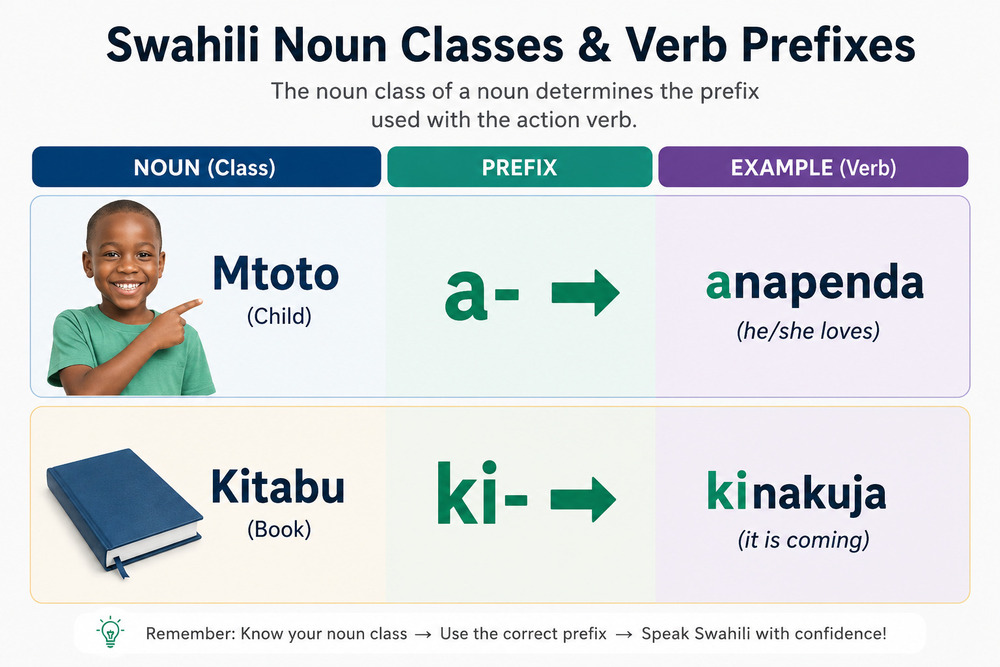
Tip for beginners: Do not try to memorise all noun classes at once. Instead, learn 2–3 common nouns from each class and observe the patterns. Over time, it will start to feel natural.
Mistake 3: Adding Unnecessary Pronouns (Direct Translation from English)
In English, you always need a subject pronoun: I am hungry. He is going. She knows.
In Swahili, the subject is already built into the verb. Adding the pronoun on top is not wrong, but it sounds overly formal or unnatural in everyday speech — a clear sign of direct translation from English.
Examples:
| English | Overformal Swahili | Natural Swahili |
| I am hungry | Mimi nina njaa | Nina njaa |
| He is going to the market | Yeye anaenda sokoni | Anaenda sokoni |
| We are learning Swahili | Sisi tunajifunza Kiswahili | Tunajifunza Kiswahili |
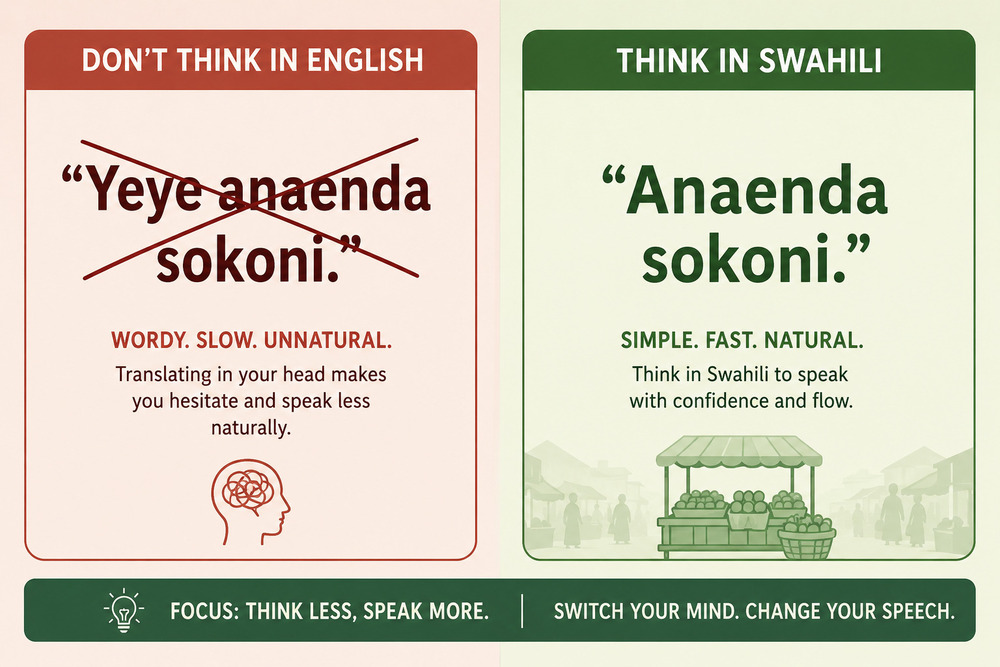
When to use the pronoun: Use mimi, wewe, yeye etc. only when you want to emphasise the subject — for example, in contrast: Mimi ninakwenda, wewe unabaki (I am going, YOU are staying).
Mistake 4: Misusing “Karibu”
Karibu is one of the first Swahili words most learners encounter. It gets translated simply as “welcome” and then used in every situation — which leads to awkward moments.
The full range of Karibu:
| Expression | Meaning | Context |
| Karibu | Welcome / You are welcome | General welcome, or response to Asante |
| Karibu ndani | Come in | Inviting someone into a home or room |
| Karibu tena | Welcome back / Come again | When someone returns or is leaving |
| Karibuni | Welcome (plural) | Addressing a group |

Common mistake:
A learner responds to Asante sana (Thank you very much) with:
❌ Karibu sana — sounds overly enthusiastic and slightly unnatural ✅ Karibu or Sawa or Nakushukuru — sounds natural and warm
Pronunciation note: Swahili vowels are pure and consistent — a, e, i, o, u are always pronounced the same way. Karibu is pronounced kah-REE-boo, never KAR-ih-byoo as English speakers often say it.
Mistake 5: Using “Hapana” in Every Situation
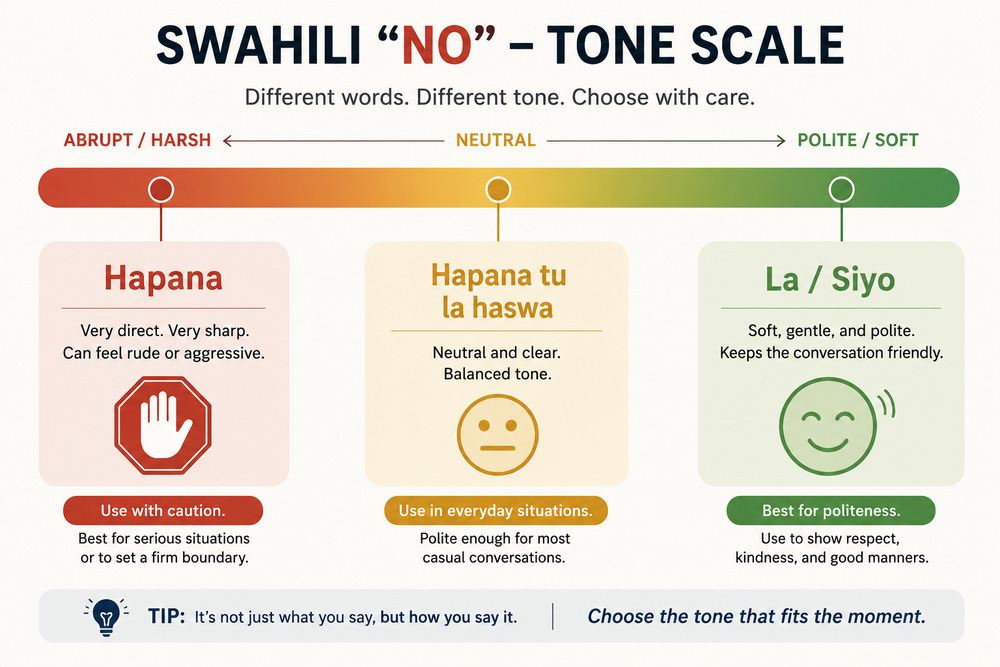
Learners are often taught Hapana = No, and they use it everywhere. But in natural Swahili conversation, Hapana can sound abrupt, child-like, or even rude depending on the context.
Know your negatives:
| Word | Best Used For | Example |
| La | Polite, simple “no” in response to a yes/no question | Unataka chai? — La, asante. |
| Siyo | “That’s not right” / Mild disagreement | Siyo hivyo. (That’s not how it is.) |
| Hapana | Emphatic refusal or commands | Hapana! Usifanye hivyo! |
Dialogue example:
Umekula? (Have you eaten?)
❌ Hapana. — Sounds blunt and abrupt ✅ La, sijala bado. — Sounds natural (No, I haven’t eaten yet.)
Making mistakes is a natural and necessary part of learning any language — including Swahili. Every error is a step closer to fluency. The key is to be aware of these common patterns so you can catch them early and correct them with confidence.
Keep practising, keep speaking, and do not be afraid to make mistakes in front of native speakers — most will appreciate your effort and help you improve.
Keep learning:
- 👉 5 Daily Inspiring Swahili Introductions
- 👉 Use 3 Powerful Conjunctions of Result
- 👉 Learn 7 Incredible Swahili Family Terms
Do you have other Swahili mistakes you have encountered in your learning journey? Tell us in the comments below! We hope this article has helped you even more in your journey to learn swahili language.
Please feel free to reach us and we will be happy to help you.
Until next time
Enjoy Learning