

In this article, we are going to see another 5 inspiring Swahili introductions. In the previous article, we saw 5 Daily Inspiring Swahili Introductions. We are going to finish up with another 5 inspiring Swahili introductions.
Today’s words are more about asking and answering. Let us explore another 5 inspiring Swahili introductions phrases and how they are used in daily life.
Table of Contents
Another 5 Inspiring Swahili Introductions
1. Asking “How Are You?” in Swahili
One of the most common phrases used when meeting someone is Hujambo, which means “How are you?”

This greeting is usually used when speaking to one person. The typical response is Sijambo, which means “I am fine” or “I have no problem.”
Example Conversation: Meeting a Friend
Ali: “Hujambo, Asha?”
Asha: “Sijambo, Ali. Na wewe?”
Ali: “Sijambo pia.”
In this simple conversation, both people greet each other politely before continuing their discussion. In Swahili culture, this type of exchange shows friendliness and mutual respect.
2. Asking “How Are You Doing?”
Another common greeting is Habari gani?, which means “How are you doing?”

This phrase is often used to ask about someone’s general well-being or how their day is going.
Example Conversation: Workplace Setting
Manager: “Habari gani, John?”
John: “Vizuri, asante.”
Manager: “Vizuri sana. Karibu kazini.”
Here, Habari Gani? opens the conversation politely. Responding with Vizuri, asante (Fine, thank you) shows appreciation and positivity.
3. Saying “I’m Fine” in Swahili
When someone asks how you are, you can reply with Sijambo, meaning “I’m fine.”
This response is commonly used when someone says Hujambo.
Example Conversation: Meeting a Neighbor
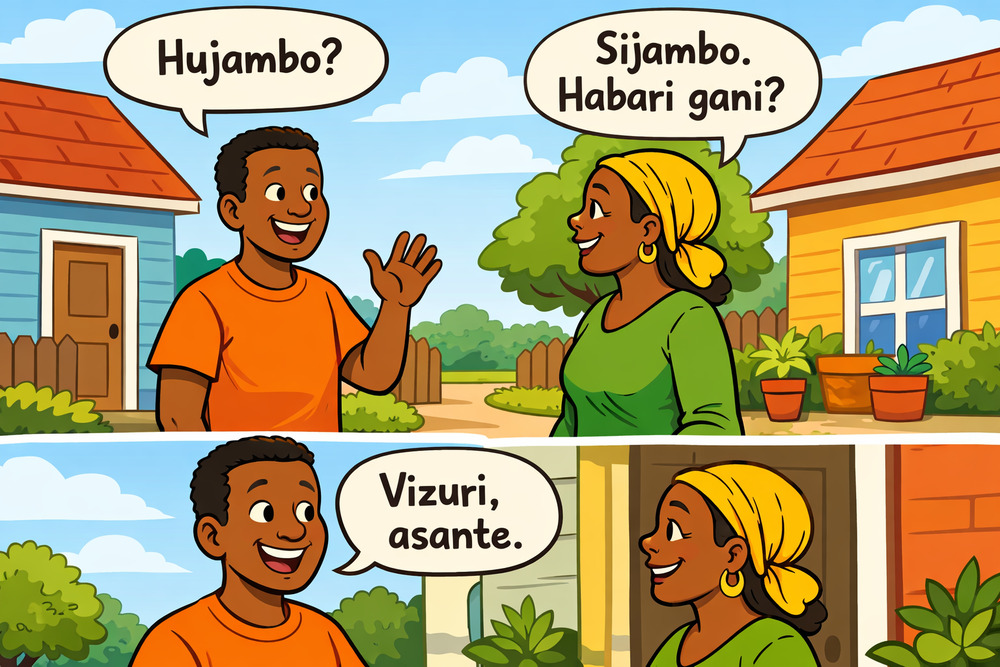
Neighbor 1: “Hujambo?”
Neighbor 2: “Sijambo. Habari gani?”
Neighbor 1: “Vizuri, asante.”
This conversation shows how greetings often flow naturally from one phrase to another.
4. Saying “Fine, Thanks.”
Another polite response is Vizuri, asante, which means “Fine, thanks.”

This phrase is used when responding to questions like Habari gani or Hujambo.
Example Conversation: Market Setting
Seller: “Habari gani?”
Customer: “Vizuri, asante.”
Seller: “Karibu. Unatafuta nini leo?”
Customer: “Natafuta matunda.”
In markets across East Africa, greetings like these help create friendly relationships between buyers and sellers.
5. Ending a Conversation: “See You Later.”
When people finish a conversation, they often say Tutaonana baadaye, which means “See you later.”
This phrase expresses friendliness and suggests that the conversation will continue another time.
Example Conversation: School Setting
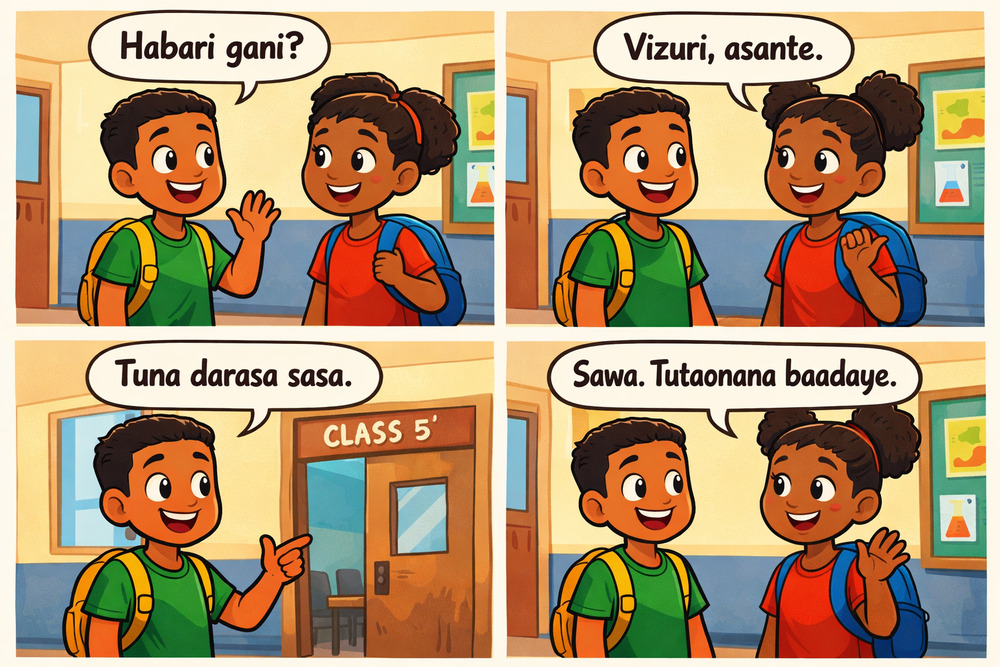
Student 1: “Habari gani?”
Student 2: “Vizuri, asante.”
Student 1: “Tuna darasa sasa.”
Student 2: “Sawa. Tutaonana baadaye.”
Students often use this phrase when leaving class or ending a conversation with friends.
In many Western cultures, conversations may start quickly without many greetings. However, in Swahili culture, greetings are an important social ritual.
People may spend several minutes greeting each other before discussing business or serious matters. This practice shows respect, patience, and genuine interest in others.
Using phrases like Hujambo, Habari gani, and Vizuri, asante demonstrates politeness and friendliness. Ending conversations with Tutaonana baadaye keeps the relationship warm and positive.
Why do you think Learning Swahili Introduction Phrases Matters? Learning these phrases is valuable for anyone interested in East African culture. They help travelers, students, and professionals communicate more effectively. They can also get help from locals.
Simple phrases such as:
Hujambo
Habari gani
Sijambo
Vizuri, asante
Tutaonana baadaye
can help you start conversations, show respect, and build connections with Swahili speakers.
Swahili introductions and greetings are an important part of everyday life in East Africa and Swahili Culture. They help people build friendships, strengthen community ties, and show respect for others.
Whether you are greeting a friend, speaking with a colleague, or meeting someone new, these simple phrases can create positive and meaningful interactions and lasting friendships.
By learning and using these expressions, you not only improve your language skills but also gain a deeper understanding of Swahili culture.
And when the conversation ends, you can always say with a smile:
“Tutaonana baadaye.” — See you later.
We hope you have enjoy another 5 inspiring Swahili introductions in this article. If you want to learn how they are pronounce in Swahili. We have put little links in the words themselves , so when you click it will take you to the audio version.
Until next time, it’s me