

In this article, we are going to Master 4 More Crucial Swahili Worker Terms to Sound Like a Local, but if you missed it, in our last lesson, we broke down five essential Swahili terms for the everyday heroes who keep our communities running. If you missed it, we covered vital roles like Mwalimu (Teacher) and Daktari (Doctor). But the conversation doesn’t stop there. To truly navigate a Swahili-speaking environment like a pro, you need to expand your vocabulary with the next set of essential roles.
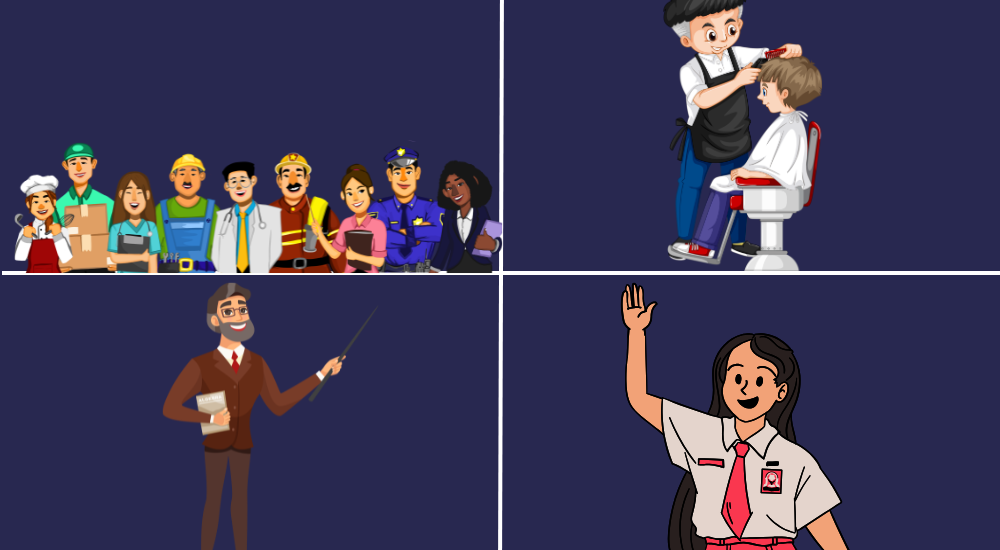
In today’s article, we are diving into four (4) more crucial Swahili words: Wafanyakazi (Workers), Mtaalamu (Professor/Expert), Kinyozi (Barber), and Mwanafunzi (Student).
Table of Contents
Just like last time, we are going beyond flat dictionary translations. We’ll find out why these roles matter in East African culture, how to pronounce them correctly, and how to use them in natural conversations.
Now let’s go through those (4) crucial Swahili words.
Master 4 More Crucial Swahili Worker Terms
Our first word to start with is:
1. Wafanyakazi (Workers)
Before we look at individual jobs, we need the master keyword that ties them all together.

Why It Matters: Wafanyakazi is the plural form of ” employee, ” ” staff, or workers. In East Africa, labor is highly respected, and referencing the collective “workers” is common in business, community updates, and daily news. Knowing this word helps you talk about teams, staff members, or labor forces seamlessly.
Pronunciation: Pronounce it as Wa-fa-nya-ka-zi. Break it down: “Wa-fa” (like “far” without the r), “nya” (a nasal blend, similar to the “ny” in canyon), “ka-zi” (which means work).
When & How to Use It: Use this when you are talking about a group of employees or workers in any setting—from an office to a construction site.
Example: “Wafanyakazi wa hoteli hii wana adabu sana.” (The workers of this hotel are very polite.)
Pro-Tip: If you want to talk about a single worker, change the prefix from “Wa-” to “M-” to get Mfanyakazi (Worker).
So that is the first word on how to Master 4 More Crucial Swahili Worker Terms.
2. Mtaalamu (Professor / Expert / Specialist)
While the word Profesa exists in academic settings, the true Swahili term for a deeply knowledgeable specialist, expert, or professor is Mtaalamu.

Why It Matters: In Swahili culture, deep knowledge and specialization are highly revered. Calling someone an Mtaalamu is a massive sign of respect. It shows you recognize their hard-earned expertise, whether they teach at a university or consult on a technical project.
Pronunciation: Pronounce it as M-ta-a-la-mu. Notice the double “a” in the middle. You need to hold that vowel sound slightly longer: “M-ta-ah-la-mu.”
When & How to Use It: Use this when speaking to or about a university professor, a technical consultant, or anyone who is a master of their craft.
Example: “Mtaalamu wa kilimo ametupa ushauri mzuri.” (The agriculture expert/professor has given us great advice.)
So that is the second word on how to Master 4 More Crucial Swahili Worker Terms.
3. Kinyozi (Barber / Barbershop)
If you want to look sharp while traveling or living in East Africa, this is one of the most practical words you will ever learn.

Why It Matters: In East African neighborhoods, the Kinyozi is not just a place to get a haircut; it is a major social hub. It’s where people meet to discuss sports, politics, and local gossip. Knowing how to find a barber is a vital part of daily integration.
Pronunciation: Pronounce it as Ki-nyo-zi. Focus on the middle syllable “nyo” (like the “nio” in onion) and end with a sharp “zi”.
When & How to Use It: Interestingly, Kinyozi refers to both the barber (the person) and the barbershop (the place).
Example: “Natafuta kinyozi mzuri wa kunyoa nywele zangu.” (I am looking for a good barber to cut my hair.) Or: “Nenda kwenye kinyozi yule pale.” (Go to that barbershop over there.)
So that is the third word on how to Master 4 More Crucial Swahili Worker Terms.
4. Mwanafunzi (Student)
No matter your age, if you are reading this, you are currently an Mwanafunzi of the Swahili language!

Why It Matters: Education is a massive pillar of pride in East African households. Calling someone an Mwanafunzi carries a connotation of growth, effort, and future promise.
Pronunciation: Pronounce it as Mwa-na-fu-nzi. The ending “nzi” is tight and buzzy, like the sound of a bee.
When & How to Use It: Use this for school children, university students, or anyone undergoing a period of learning and training.
Example: “Yeye ni mwanafunzi katika Chuo Kikuu cha Dar es Salaam.” (He/She is a student at the University of Dar es Salaam.)
Pro-Tip: To talk about students in the plural, change “Mwa-” to “Wa-” to get Wanafunzi (Students).
So that is the fourth word on how to Master 4 More Crucial Swahili Worker Terms.
For today we have seen Master 4 More Crucial Swahili Worker Terms. We will continue with this series for a while.
Expanding your vocabulary to include these terms does two powerful things for your language journey:
It Contextualizes Your Interactions: You aren’t just pointing at people anymore. You can now talk about the “expert” (mtaalamu), locate a local hub like the “barber” (kinyozi), and describe groups of “workers” (wafanyakazi) managing a business.
It Establishes Common Ground: Locals love it when a learner uses precise terms. Saying Mtaalamu instead of just “huyu mtu” (this person) immediately elevates your conversational level.
What Do You Think?
Taking your Swahili step-by-step is the absolute best way to build lasting fluency. Now that you’ve mastered these four crucial terms, you’re ready to use them in the real world.
Which of these four words do you think you’ll need to use first on your language journey? Are you currently a student (mwanafunzi), or are you an expert (mtaalamu) in your career?
Let me know in the comment section below! And if you’re ready to keep pushing forward, check out our other practical Swahili guides right below.
We hope you have benefited with how to Master 4 More Crucial Swahili Worker Terms. Until next time, continue to Master 4 More Crucial Swahili Worker Terms.
Let us know what other words you would like to learn or see in our weekly articles.
When you want to start studying Kiswahili, please reach out to me by clicking my initials below.👇
Until next time, Happy Learning.